When the Real Estate Market Is Being Transformed by PropTech
The real estate industry, which depended largely on traditional ways and face-to-face negotiations, is now changing very fast. With the help of technology, it has become cheaper, easier, and more transparent to buy, sell, or manage properties. The change is majorly due to the rise of PropTech, which is an acronym for Property Technology and represents a fusion of one tech innovation sector with another (real estate) to enhance the customer experience.
Currently, PropTech disruptions are radically changing each level of the property the-street-newspaper way from the internet searches and virtual tours to digital payment and intelligent building management. The outcome is a real estate industry that is more interconnected, data-driven, and customer-centric than ever before.
What Is PropTech and Why Does It Matter

In essence, PropTech is all about the adoption of advanced digital solutions that make less complex the various property-related activities less complex. The concept spans the gamut of innovations and may include such things as AI-powered property valuation, immersive virtual tours of a home, blockchain to execute smart contracts, and IoT-enabled devices in the smart home.
The real estate market has been burdened with the likes of slow paperwork, lack of transparency, and, in general, inefficiency. PropTech is very instrumental in remedying such problems as it ushers in automation, accuracy, and the digital convenience of conducting business. It thus becomes possible to have faster transactions, better decisions through the use of data, and easier communication among the different parties involved – buyers, sellers, agents, and property managers.
To sum up, PropTech is more than just an instrument; it is the means that connects the tangible realm of real estate to the inexhaustible technological resources.
The Forces Driving PropTech’s Growth
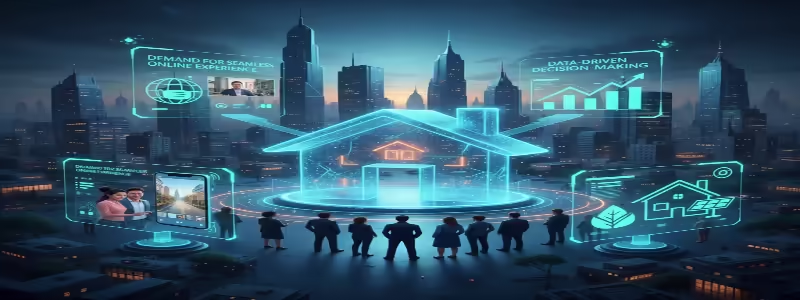
The growth of real estate technology has been largely influenced by several major factors. One of these factors is the fact that today's buyers demand a smooth online experience in the same way as they do when buying products or booking a trip. The younger generations, i.e., millennials and Gen Z, prefer digital communications, remote tours, and immediate access to the authenticated property data.
The COVID-19 pandemic was, in a way, a major accelerator of the adoption process too. Since physical visits were limited, the industry resorted to virtual tours, remote document signing, and online communication tools. What was initially a workaround for the crisis has, in fact, become the core of the contemporary real estate experience.
The emphasis on data-driven decision-making is another major factor that has been pointed out for the trend. Developers and investors, thanks to the large amount of data at their disposal, can now predict property trends, values, and buyer behavior up to a very high level of accuracy. As a result of this, the increasing awareness of the environment has led to the rise in the popularity of intelligent, green buildings in which the technology is used for energy saving and environmentally friendly living.
PropTech Innovations Transforming the Industry
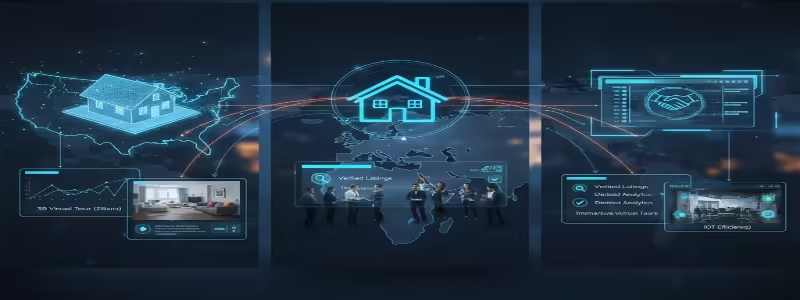
One of the most significant changes that the PropTech sector has undergone is the advent of numerous high-tech innovations, which are changing the face of real estate one by one.
Among many, these revolutionary ideas leading to the success of the real estate industry are:
Virtual and Augmented Reality
Without a doubt, the duo of Virtual Reality (VR) and Augmented Reality (AR) is the fundamental reason for an absolute change in the way people see and interact with real estate properties.
By means of virtual tours, buyers are empowered to familiarize themselves with properties independently and without a co-location.
On the other hand, with the help of augmented reality, they can also visualize the placement of the furniture, the change of the wall colors, and the latest decoration trend, even if they have not yet made up their minds.
These techs are time-efficient, highly engaging, and at the same time, open up global markets via the ability to do remote viewings.
Artificial Intelligence and Machine Learning
AI and ML are major components of the evolution of real estate technologies, which offer predictive analytics, customer service, and automated valuation tools. AI-based chatbots are on the go in buyer assistance, whereas machine learning systems aid in price forecasting, spotting investment opportunities, and buyer-seller matching.
By providing exact and personalized solutions, AI replaces speculation with certainty in real estate.
Blockchain and Smart Contracts
By introducing security and transparency, Blockchain paves the way for effortless property transactions.
One of the key features, smart contracts, enables the automation of contract execution when the conditions have been fulfilled, hence, the elimination of fraud and mistakes is achieved.
Moreover, Blockchain technology grants the possibility of fractional ownership thus an investor can buy a few shares of a property instead of the totality of the asset. This brings the advantage of the property market being accessible to smaller investors and liquidating it further.
Internet of Things and Smart Buildings
The Internet of Things (IoT) merges gadgets and methods in structures, hence giving capabilities such as automation and live monitoring. Remote operations can cover aspects such as lighting, air conditioning, water usage, security, and much more in the smart home of the future.
IoT also does wonders for property managers through predictive maintenance warnings, which is a sure way to beat costly fixes. Besides that, by perfecting energy utilization and lessening waste, IoT further contributes to environmental friendliness.
Big Data and Predictive Analytics
The term “data is the new oil” has never been more applicable than in real estate. By employing big data analytics, enterprises get to know what buyers want, follow market changes, and forecast upcoming trends.
With this in place, the choices made by developers as well as agents could get quite a lot of input from economic activities, such as determining prices or project work, instead of having to rely on intuition of which has to be real.
Digital Twins
Basically, the digital twin is a near-complete copy of the real property existing virtually. It is extremely helpful as it allows the different stakeholders, such as the architects, the engineers, and the developers, to run test cases, perform simulations, and gauge maintenance requirements all in real-time.
Digital twins not only boost the work process by cutting down the time that would usually be spent on it, but they also help in raising safety standards while big projects or complex situations take place.
Cloud-Based Property Management
With the help of cloud services, the process of taking care of properties has been made so much easier that it is unrecognizable compared to the old way of doing things. Kin landlords and a real estate firm members can carry out their duties that include rent collection, maintenance, tenant communication, and more through reliable and centralised platforms.
Not only does this work progressively, it also allows property owners to quickly get the pulse of performance, occupancy, and revenue.
How PropTech Is Changing the Experience for Everyone

PropTech is a good thing not only for one group but is actually having a positive impact on the experiences of all the players of the real estate ecosystem.
For Buyers and Tenants
In fact, technology has taken much of the pain out of the property search and has made the whole process more transparent. Buyers should be able to:
Inspect real estate listings that have been verified via the web.
Go through 3D virtual tours.
Compare market data in no time.
Sign contracts in a secure manner from any location.
The digital convenience that comes with it is a great time saver, lessens the chances of making wrong steps in the decision process, and turns property decisions into something one can do confidently and even have fun with.
For Real Estate Agents
Instead of being replaced by real estate technology, agents are actually being empowered by it. Agents using the CRM system, the automated marketing tools, and the AI-based analytics can concentrate on building relationships with clients and hardly need to engage in manual work. They get deeper insights, have the possibility to address a larger number of people online, and are able to do business at a quicker pace.
For Developers and Investors
Developers are progressively adopting PropTech instruments, not only to assess market demand but also to keep track of construction progress as well as managing projects from a distance. Investors are opening the door to revenue opportunities through real-time market data, risk evaluations, and online property exchanges that bring about the possibility for them to build smarter and diversified portfolios.
For Property Managers
Thanks to IoT gadgets and management programs, property managers are in a position to allow for tenant requests, maintenance, and rent collection to be done smoothly and with minimal intervention from them. Automated systems that are always on the lookout for leaks, monitor energy usage, and are in charge of repair scheduling are among the reasons why money is saved, and tenant satisfaction levels are also high.
The Role of Digital Transformation in Real Estate
The shift of the real estate sector towards digital means is far beyond just the adoption of new tools; it is essentially about changing the entire way the industry works.
It has become the primary focus to offer 'experiences' rather than merely conducting 'transactions'. Real estate firms are digitalizing their operations, automation their everyday tasks, and using data analytics for their business decisions.
The most significant changes to the industry driven by technology are:
Interacting online primarily via websites and mobile apps
Cloud-supported storing of documents and digital payments
Using AI to give the most accurate pricing and best marketing strategies
It is through digital platforms that the agents, lawyers, and clients can work more efficiently.
Finally, this kind of transformation results in a real estate market that is faster, more transparent, and technologically advanced, with the customer being at the center.
Global and Regional Examples of PropTech in Action
Several PropTech executives worldwide are leading a change that will shape the industry for the next decades:
Zillow, which is located in the U.S., is using AI and big data in order to have the most accurate home value estimations.
Matterport is digitally replicating the real-world property in 3D to provide users with a virtual property tour that is almost the same as the real one.
WeWork is employing IoT and smart technology to not only make shared workspaces more efficient but also more comfortable.
Propy has put blockchain into motion as a means for carrying out safe, paperless real estate transactions.
A platform like Property Finder and Bayut in the Middle East, by giving verified listings, detailed analytics, and immersive virtual tours, has completely changed the way people look for real estate.
The instances here indicate that PropTech is a worldwide movement that is changing the entire property sector and is not just confined to a specific region.
Challenges Along the Way

PropTech has difficulties as well, just like any other digital revolution.
The privacy of data and security on the internet are still the biggest worries, while more and more personal and financial information is being transferred online. The traditional stakeholders might also resist the change, as they would prefer the old ways of working.
Moreover, the use of advanced technologies such as AI and IoT might be expensive for small real estate companies. The regulation of blockchain transactions and digital ownership is at a stage of change in different parts of the world.
Still, as the sector is going on to be mature, the collaboration of tech companies, governments, and real estate players is breaking down these walls.
What the Future Holds for PropTech
The future of real estate technology is full of promise. With the help of AI, clients will get tailor-made property recommendations and access to the latest investment insights, thus we are heading to a hyper-personalization era. Environmental protection will continue to be the main concern, as green PropTech will enable energy-efficient measures and eco-friendly designs.
On the one hand, new areas such as metaverse real estate where one can buy virtual properties and sell them in a digital environment will be available for investments. On the other hand, the use of robotics and automation will be extended to make property construction, cleaning, and maintenance more efficient.
Conclusion: Building a Smarter Real Estate Future
PropTech advancements are changing the real estate industry radically. The area is going for a more intelligent, quicker, and transparent way of doing things with innovations such as online property searching and blockchain transactions.
The real estate market’s shift to digital is profoundly affecting lifestyle, investment, and property-related interaction. The point is not to substitute the experts with machines but rather to improve the experts’ work by the use of technology.
There is no doubt that the future is different. PropTech is not simply altering real estate; it is actually transforming the way we live in the spaces that we call home.